π and Liu Hui
Working about 500 years after Archimedes, the Chinese mathematician Liu Hui found a way of approximating π which is in some ways similar to Archimedes' method (of which Liu Hui seemed to be unaware), but in other ways quite different. He produced a more accurate approximation than Archimedes, one which would last for many centuries.
Like Archimedes, he started with a hexagon inscribed in a circle, and then repeatedly doubled the number of sides of the polygon. Unlike Archimedes, he considered area, not perimeters.
The main series considers the side lengths of polygons inscribed in a circle of unit radius. Starting with a hexagon, one has x0=1, and then x1 is the side-length of the 12-sided polygon, and a little more than 0.5, etc.
The basic recurrance formula is
xn+1=√(2 - √(4 - xn2))
The area of the inscribed polygon with 6*2n sides of length xn is
An=3*2n-1*xn-1
This must be a lower bound on π. But he also gave an upper bound
An < π < 2An - An-1
And he gave a best approximation within the range.
π =(4An - An-1)/3
So there are four things to prove.
xn+1=√(2 - √(4 - xn2))
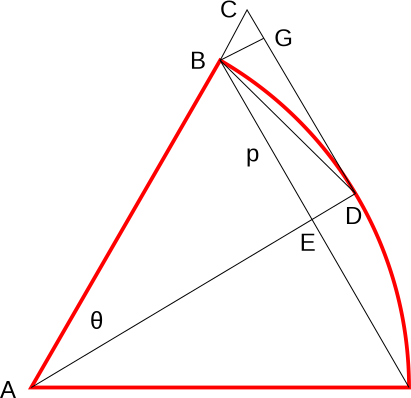
given 2p, i.e. the edge of a polygon with n edges, what is the straight-line distance BD, the edge of a polygon with 2n edges? The answer comes from using Pythagoras's theorem a lot.
In triangle ABE, AE=√(1-p2).
As AD=1, DE=1-AE=1-√(1-p2).
In triangle BDE, BD=√(p2+DE2)
BD=xn+1 and 2p=xn, so
xn+1=√(p2+(1-√(1-p2))2)
=√(p2+1-2√(1-p2)+(1-p2))
=√(2 - 2√(1-p2))
=√(2 - √(4-(2p)2))
=√(2 - √(4-xn2))
An=3*2n-1*xn-1
There are many claims on the internet that the area of a regular polygon inscribed in a circle is
A=0.5*n*r*l
Where n is the number of sides, r the radius of the circle, and l the length of the polygon's sides. Really? Consider a hexagon inscribed in a unit circle. The hexagon is made up of six equilateral triangles with unit side. So r=1, l=1, n=6 and A=3. This implies that the area of an equilateral triangle with unit side is 0.5. Unfortunately, it is not. It is 0.25√3, which is approximately 0.433.
The confusion arises because A=0.5*n*r*l is correct, but r is the radius of the circle inscribed in the polygon, or, equivalently, it is correct for polygons circumscribed on a circle.
Again considering the above diagram, one can ask what the area of the triangle ABD is. Given that AB=1 and is the circle's radius, and BE=p is perpendicular to AD, the answer is simply p/2 (half base times height). And 2p is the side length of the polygon with half as many sides as the one which has BD as a side. So for a regular polygon with n sides there are n triangles whose area is a quarter of the side-length of the inscribed polygon with half as many sides, i.e. prior to the doubling step.
In our sequence the number of sides is 6*2n, i.e. a hexagon at n=0, so
An=6*2n*0.25*xn-1
An=3*2n-1*xn-1
And perhaps surprisingly the duodecagon inscribed in a unit circle has an area of exactly three. It is formed of twelve isosceles triangles whose two equal sides have length one, and the angle between them is 30° (i.e. 360°/12). Such a triangle has an area of 0.25 (best seen by considering its height perpendicular to one of the equal sides, which is sin(30°)).
Note also that the above is extremely similar to the Archimedes method of considering the perimeter. The perimeter will be 6*2n*xn, and the values of xn between Archimedes (diameter equals one) and Liu Hui (radius equals one) differ by a factor of two.
π < 2An - An-1
The n triangles congruent to ABD make a polygon which lies entirely within the circle, which proves that An<π. But if one considers the n shapes congruent to ABGDA, then they fully enclose the circle, and therefore their area must be greater than the circle's area.
The difference between the areas of ABGDA and ABD is simply the triangle BGD. The triangle BGD is identical to the triangle BDE. The difference between An+1 and An is the addition of a set of triangles like BDE. Add the same set again, and one has an area which exceeds the circle's area. So
An-1 + (An - An-1) = An < π
An-1 + 2(An - An-1) = 2An - An-1 > π
π ≈ (4An - An-1)/3
The diagram makes it clear that the area BDE following the arc of the circle from B to D is closer to that of the triangle BDE than to the rectangle BGDE. But how much closer?
It is equivalent to consider by how much BD exceeds BE, and we wish to consider the situation for large numbers of sides, so small θ. Then AE is almost one, and sin(θ) is almost p. The angle DBE is θ/2, and BE/BD=cos(θ/2) or approximately 1-θ2/4. Alternatively BD/BE≈1+θ2/4≈1+p2/4.
To a first order approximation, at each iteration x halves, and the area stays constant due to the extra factor of two generated by 2n-1. But the above shows that the next order term will give not
xn+1≈0.5xn
but
xn+1≈0.5xn(1+xn2/16)
if p=0.5xn. This means that the area is not constant, but increases by a factor of approximately
(1+xn2/16)
at each iteration. So we can now calculate an approximation to
(An+1 - An)/(An - An-1)
This will simply be xn+12/ xn2=1/4.
So at each step, the change in A is a quarter of what it was at the previous step, approximately. So, if we have calculated An and An-1, we can define Dn=An- An-1, and write:
An=An-1 + Dn
An+1≈An-1 + Dn + (1/4)*Dn
An+2≈An-1 + Dn + (1/4)*Dn + (1/16)*Dn
And ultimately
A∞≈An-1+Dn*(1 + 1/4 + 1/16 + 1/64 +...)
The sum of the geometric progression whose common ratio is a quarter is 4/3. So
A∞≈An-1 + (4/3)*Dn
≈An-1 + (4/3)*(An - An-1)
≈(4An - An-1)/3