π and Archimedes
Archimedes, c.250BC, found an iterative sequence which converges to π by considering polygons inscribed in, and circumscribed on, a circle. The maths is roughly as follows.
Let us start with the difficult part. If we have two polygons, one inscribed in a circle, one circumscribed, can we double the number of sides and still work out their lengths?
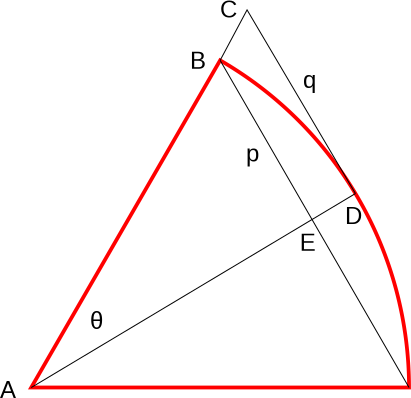
In the above diagram, BE, length p, is half of one edge of an inscribed polygon. And CD, length q, is half of one edge of a circumscribed polygon. Although eventually we wish to use a circle of unit diameter, it is easier to work initially on a circle of unit radius. If the circle is of unit radius, the lengths of AB and AD are one. Two identities are then obvious:
p=sin(θ)
q=tan(θ)
Considering the triangle ACD, cos(θ)=1/AC. And considering the similar triangles ABE and ACD, BE/AB=CD/AC, or p/1=q/AC. So 1/AC=p/q, and we have
p/q=cos(θ)
If at each step we wish to halve θ so as to double the number of sides of the polygons, can we express p and q in terms of their previous values, denoted p' and q', which relate to an angle of 2θ?
The formula sin(2θ)=2sin(θ)cos(θ) is well-known. So we have
p'=sin(2θ)
=2sin(θ)cos(θ)
=2p*p/q
p=√(q*p'/2)
A less well-known identity is
tan(θ/2)=sin(θ)/(1+cos(θ))
which is equivalent to
tan(θ)=sin(2θ)/(1+cos(2θ))
So here
q=tan(θ)
=sin(2θ)/(1+cos(2θ))
=p'/(1+p'/q')
=p'q'/(p'+q')
Now we must consider the total perimeter, not just the length of half a side. The number of sides, n, doubles at each step, and our estimates for π will be np and nq, or, for the previous step, n'p' and n'q' with n'=n/2.
So if we set a=nq, b=np, a'=n'q'=nq'/2, b'=n'p'=np'/2, the relation
q=p'q'/(p'+q')
becomes
a/n=(2b'/n)(2a'/n)/((2b'/n)+(2a'/n))
a=2a'b'/(a'+b')
and
p=√(q*p'/2)
becomes
b/n=√((a/n)*(2b'/n)/2)
b=√(ab')
And so we arrive at
ak+1=2akbk/(ak+bk)
bk+1=√(ak+1bk)
The values of a0=2√3 and b0=3 starts the sequence with hexagons and a circle of unit diameter, so one whose circumference is π. These give the sequence already quoted, which starts
 0: 3.0000000000 < pi < 3.4641016151
 1: 3.1058285412 < pi < 3.2153903092
 2: 3.1326286133 < pi < 3.1596599421
 3: 3.1393502030 < pi < 3.1460862151
 4: 3.1410319509 < pi < 3.1427145996
The last term above corresponds to polygons of 96 sides, the point at which Archimedes stopped. However, Archimedes used fractions, not decimals, and occasionally rounded them to something more convenient. He also had to approximate √3, using 1351/780<√3<265/153. So his final range was slightly larger than the above, at 223/71<π<22/7 which is 3.1408<π<3.1429. Others have explained Archimedes' working in great detail.
One could start with other regular polygons. Can you find the starting values for triangles (which then gives the hexagon sequence, but with an extra initial stage) and squares? Most polygons do not produce starting values which can be calculated readily using just square roots.