arctan(1/2) + arctan(1/3) = arctan(1)
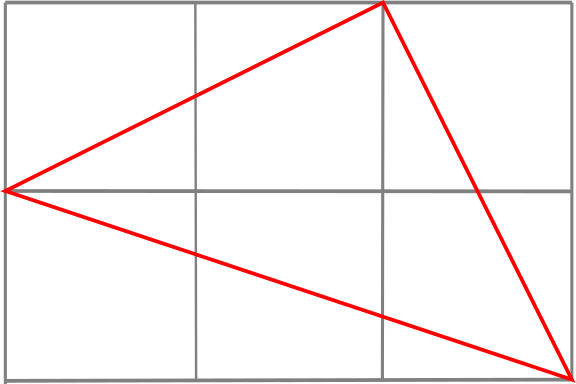
The red triangle is an isoceles triangle, with the two equal sides having length of √5 if the grey grid is of unit squares.
The angle at the top of the triangle is a right-angle -- either consider rotating the red triangle about its left vertex until the top vertex is on the same horizontal line as the left vertex, and note that the other vertex is now vertically below it, for before the rotation the angle between the horizontal and the line from left to top vertex was the same as the angle between the vertical and the line from top to right vertex, or note that the longest side has length √10, so the triangle is Pythagorean with hypotenuse length √10 and two sides of length √5.
The angle at the left vertex of the triangle must be half a right-angle, and its tangent is one. Note that is is formed by adding two angles, that between the horizontal line and the red line to the top vertex, and that between the horizontal line and the red line to the bottom vertex. The first of these angles has a tangent of 1/2, the second of 1/3. Therefore
arctan(1/2) + arctan(1/3) = arctan(1)
Similar arguments will produce other identities, such as
arctan(3/5) + arctan(1/4) = arctan(1)
arctan(2/5) + arctan(3/7) = arctan(1)
For fastest convergence, one wants the largest argument to the arctan function to be as small as possible. If arctan(1) is being reduced to the sum of two arctangents, the best possible will be around arctan(0.414), so 3/7=0.429 is quite close to optimal, but nowhere near as good as using 4*arctan(1/5)-arctan(1/239).
One could compare the convergence using the 1/2 and 1/3 pair with that using 2/5 and 3/7 or even 5/12 and 7/17. One should be able to show that these pairs are of the form a/b and (b-a)/(b+a).